

That's a Wrap
The mental health signal we can’t afford to ignore in 2026

This has been a year.
Like many of you, I’m looking forward to taking some time off. Time to slow down, spend time with family, and get myself ready for everything that’s going to need attention in the new year. And there’s a lot coming.
While we’ve made real progress in how openly we talk about mental health, it’s still not enough.

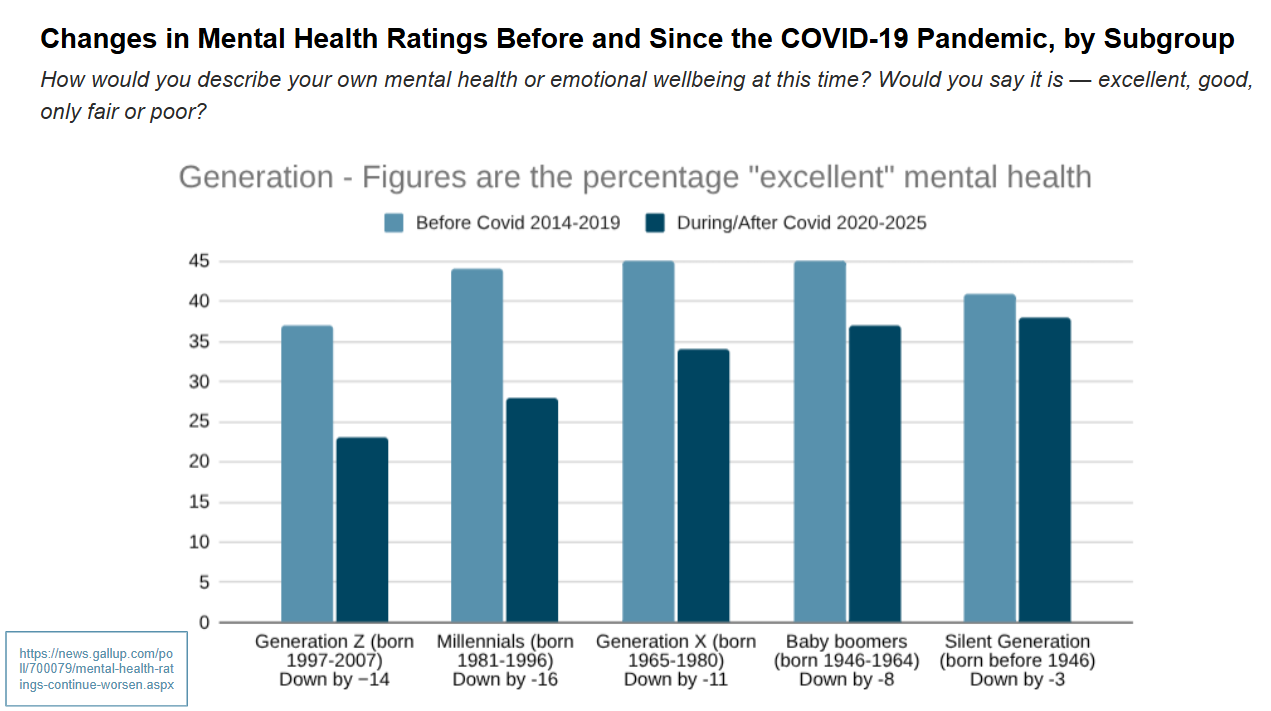
Consider the results from Gallup’s latest poll. For the first time, fewer than 30 percent of U.S. adults rate their mental health as “excellent.” Before the pandemic, that number was 43 percent. Seventy-two percent still say their mental health is excellent or good, but even that combined figure is now at a historic low.
The declines show up across every major demographic group, but they’re especially pronounced among younger adults. Gen Z and millennials have seen roughly a 15-point drop in excellent mental health over the past six years. At the same time, visits to mental health professionals have increased sharply, particularly among younger generations.
I can’t say I’m surprised.
There’s a lot going on in the world. Economic uncertainty, political tension, environmental disasters, social fragmentation, constant noise, and so much more. Our society isn’t growing in ways that naturally give people the connection, stability, and support they need to manage all of this. We’re more aware, sure, but not necessarily more supported.
That’s a problem. A big one.
And it’s why I write here.
Not because I have all the answers. I don’t. But because we need a better dialogue about what comes next. What we’re doing now for mental health isn’t working well enough, and pretending otherwise doesn’t help anyone.
I’ve said it once, and I will say it again, mental health can’t live only in awareness campaigns or individual coping strategies. It has to show up in policy. In workplace practices. In how we design systems that people are expected to live inside every day. In our communities.
Gallup’s data makes something else pretty clear to me: after two decades of stability, Americans’ mental health has declined steadily since 2020, while physical health ratings have remained relatively flat. COVID was a whopper to all of us, but to see the trends, it’s more than a little concerning.
Younger adults, in particular, are feeling this most. They are more likely to report worse mental health, and they are also more likely to seek help. That openness is a strength. But it also highlights something important: the environment they’re navigating is demanding more than it gives back.
As we head into 2026, this feels like the challenge in front of us.
I’ll be out until the new year, taking the break I know many of us need. When I’m back, this work continues with the same focus it’s always had: asking harder questions, grounding the conversation in data and lived experience, and pushing for approaches that actually make life more sustainable.
Thank you for reading, supporting, and engaging this year. Rest if you can. Reflect if you need to. We’ll pick this back up soon.
Happy Holidays, and Happy New Year!
The data here points to a gap that individual insight alone cannot close. People are more willing to talk about mental health and more likely to seek care, yet overall well-being continues to slide. That mismatch suggests the problem sits less with awareness and more with the conditions people are living and working in every day. Shifting the focus toward policy, systems, and environments feels necessary if we want the trend to change rather than just be documented.
Thank you for this analysis, I've been thinking a lot after the Reiner tragedy about how the mental health care system in this country fails families, I wrote this about my daughter's time in treatment, and how learning Nonviolent Communication was what really helped our family: https://listen2connect.substack.com/p/kids-speak-in-metaphorcan-parents